AI Agent QGIS Plugin: The Most Powerful AI Agent for QGIS
Published

AI Agent by TerraLab is a free QGIS plugin that answers geospatial questions inside QGIS. On GeoKTools and GeoExpertQueries, the two geospatial benchmarks Google Research published in October 2026, it scored 43.8 out of 100 on 41 held-out questions at Low effort (GPT-6 Luna), against 24.9 for Claude Sonnet 5.5 driving QGIS through the nkarasiak QGIS MCP server in Claude Code, 22.1 for GPT-6 Luna through the jjsantos01 QGIS MCP server in OpenAI's Codex, and 21.0 for GPT-6 Luna alone with no tools. That is the highest score of every AI agent we tested in QGIS, in runs from 16 to 20 October 2026 graded by Google's own scoring code.
You ask a question in a prompt, about flood risk, travel times or water stress, and the plugin does the GIS work: it finds the data among 9,901 open datasets, runs the analysis with 226 QGIS tools and adds the result to your project as layers, with its sources named. It comes from TerraLab, the team behind AI Segmentation and AI Edit. Our QGIS plugins have passed 144,000+ downloads on the official QGIS repository, and we built AI Agent for the people who use them every day.
- AI Agent QGIS plugin (Low: GPT-6 Luna)
- Claude Sonnet 5.5 + QGIS MCP (nkarasiak, Claude Code)
- GPT-6 Luna + QGIS MCP (jjsantos01, Codex)
Accuracy from 0 to 100 on GeoKTools and GeoExpertQueries, Google Research's benchmarks for geospatial agents (arXiv:2610.15750): the 41 held-out questions with no link to our tuning, graded by Google's own scoring code, mean of 3 runs. The plugin at Low effort, the setting on the free plan.
What did AI Agent score on Google's geospatial benchmarks?
| AI Agent QGIS plugin(Low: GPT-6 Luna) | Claude Sonnet 5.5 + QGIS MCP(nkarasiak, Claude Code) | GPT-6 Luna + QGIS MCP(jjsantos01, Codex) | GPT-6 Luna alone(no tools) | |
|---|---|---|---|---|
GeoKTools 30 questions Google's deterministic offline scorer Deterministic scorer | 53.5Low effort | 33.3 | 39.5 | 44.2 |
GeoKTools 30 questions Google's report protocol: exact match, else Gemini 3.8 Flash judge Google's report protocol | 36.9Low effort | 23.3 | 27.0 | 28.7 |
GeoExpertQueries 11 questions Tool-agnostic autorater, Gemini 3.8 Flash, 3 judge runs Autorater, 3 judge runs | 62.6Low effort | 29.3 | 8.6 | 0.0 |
All 41 questions 41 questions Both benchmarks, Google's report protocol Google's report protocol | 43.8Low effort | 24.9 | 22.1 | 21.0 |
Scores from 0 to 100, mean of 3 runs per system, every scorer Google's own and unchanged: the deterministic scorer, the report protocol and the GeoExpertQueries autorater. AI Agent ran at Low effort (GPT-6 Luna) on 20 October 2026; Claude Sonnet 5.5 + QGIS MCP (nkarasiak) in Claude Code on 18 October; GPT-6 Luna + QGIS MCP (jjsantos01) in OpenAI's Codex on 16 and 17 October; GPT-6 Luna alone on 19 October. Bold marks the best score in each row.
The lead holds question by question. Of the 41 questions, AI Agent at Low effort scored higher than Claude Sonnet 5.5 + QGIS MCP (nkarasiak) on 26 and lower on 5, and higher than GPT-6 Luna + QGIS MCP (jjsantos01) on 24 and lower on 7. Its average lead over Claude Sonnet 5.5 + QGIS MCP (nkarasiak) is 19 points, between 10 and 29 with 95% confidence.
- Higher
- Tie
- Lower
For each question, AI Agent at Low effort (GPT-6 Luna) against Claude Sonnet 5.5 + QGIS MCP (nkarasiak) in Claude Code, each averaged over 3 runs. Google's report protocol on GeoKTools, the autorater on GeoExpertQueries.
What are GeoKTools and GeoExpertQueries?
They are the two benchmarks Google Research released with its paper on the Google Earth AI Geospatial Reasoning Agent (arXiv:2610.15750, 11 October 2026). The questions are public in the google-research/geospatial-reasoning-benchmarks repository, under CC BY 4.0; Google keeps its official test questions private.
- GeoKTools asks factual questions whose answers need one to four kinds of geospatial data: a boundary, a statistic, a weather record, a count of places. Google's deterministic scorer gives partial credit with a 10% tolerance on numbers; its report protocol requires an exact match or a judge's approval.
- GeoExpertQueries asks open problems an analyst would get, in domains such as site selection, natural hazards and public health. Google's autorater grades each answer against workflows written by experts.
What can an AI agent do in QGIS?
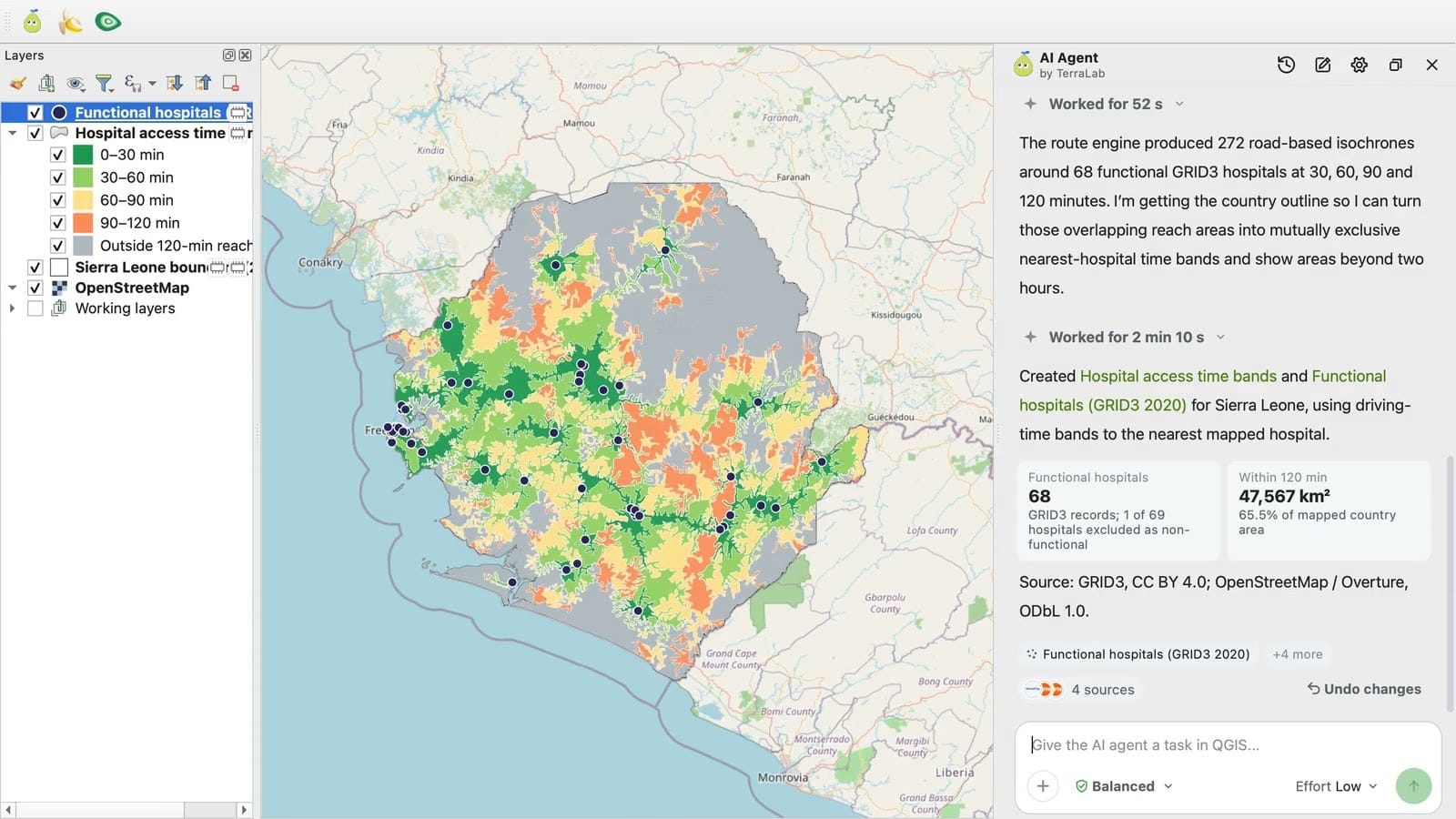
It answers questions about places by working with real data inside QGIS: it finds datasets, runs spatial analysis such as travel times, overlays or statistics per area, and returns a map with its sources. Three examples, each filmed from an empty QGIS project on Low effort, the setting on the free plan. The first comes from Google's paper. We wrote the other two in the same style, and none of them is among the scored questions.
- Question
- Map the travel time for a pregnant woman to reach the nearest hospital for an emergency delivery, from anywhere in Sierra Leone. Use travel time, not straight-line distance.
- Answer
- The plugin first asked how people travel and which facilities should count. With driving, and every mapped hospital as a stand-in, it mapped the time to the nearest of 68 hospitals in 30-minute bands: 65.5% of the mapped country lies within two hours. About 5 minutes.
- Why it is hard
- It needs road travel time across a whole country, not straight-line distance, and a choice about which facilities count that no model can make from memory.

- Question
- How water-stressed is the area around Phoenix, Arizona? Give the WRI Aqueduct baseline water stress there and show it on the map.
- Answer
- Extremely High, above 80%. The 8 WRI Aqueduct basins that cross the city give an area-weighted score of 4.86 out of 5, with the source and its licence named. About a minute.
- Why it is hard
- The answer has to come from one named dataset, combined over every basin the city overlaps, not from what a model remembers about Phoenix.

- Question
- How many days went above 35 °C in Kern County, California last summer (June to August 2026)? And which hospital is nearest to Bakersfield, the county seat?
- Answer
- 61 of 92 days above 35 °C at the Bakersfield airport station, with a note that this is one station, not a county average. The nearest hospital is Mercy Hospital, 0.76 km from the city centre. About 2 minutes.
- Why it is hard
- It joins three sources, daily weather records, a hospital register and a map of places, for a summer too recent to answer from memory.
Is a QGIS AI plugin better than Claude or ChatGPT with a QGIS MCP server?
On these benchmarks, yes. A QGIS MCP server connects a chat model such as Claude or ChatGPT to QGIS through the Model Context Protocol, so the model can call QGIS functions. The model can then operate QGIS, but it still has to find the data, choose each step and check its own work. A language model with no connection answers from memory.
The AI Agent QGIS plugin gives the model what it needs for geospatial work: tools made for GIS, licensed data it is allowed to use, and a check on every result before it answers. It works directly inside QGIS, so the model acts on real layers with real QGIS tools, and you can open every result in your project.
The clearest comparison is one model, three ways. On its own, GPT-6 Luna recalls some GeoKTools answers and scores 0 on every GeoExpertQueries task. Connected to QGIS through the jjsantos01 QGIS MCP server in OpenAI's Codex, it scores about the same. Inside the plugin at Low effort, the same model scores 53.5 on GeoKTools and 62.6 on GeoExpertQueries.
- GPT-6 Luna alone (no tools)
- GPT-6 Luna + QGIS MCP (jjsantos01, Codex)
- AI Agent QGIS plugin (Low: GPT-6 Luna)
GeoKTools with Google's deterministic scorer, GeoExpertQueries with its autorater. GPT-6 Luna + QGIS MCP ran with the jjsantos01 server in OpenAI's Codex on 16 and 17 October, not the nkarasiak server and Claude Code used for Claude Sonnet 5.5. AI Agent's Low effort runs GPT-6 Luna. All three GPT-6 Luna setups used high reasoning.
The plugin leads at every level of difficulty. Each GeoKTools question needs several kinds of data. With two kinds, it scores well ahead of every other system. With four, every system struggles, and the plugin stays ahead.
- AI Agent QGIS plugin (Low: GPT-6 Luna)
- Claude Sonnet 5.5 + QGIS MCP (nkarasiak, Claude Code)
- GPT-6 Luna + QGIS MCP (jjsantos01, Codex)
- GPT-6 Luna alone (no tools)
- AI Agent, live data (Low: GPT-6 Luna)
Scored with Google's report protocol, on the 30 held-out GeoKTools questions with no link to our tuning: 20 need two data types, 5 need three and 5 need four. Every question needing one came from a template we studied before the split, so that group is left out.
- AI Agent QGIS plugin (Low: GPT-6 Luna)
- Claude Sonnet 5.5 + QGIS MCP (nkarasiak, Claude Code)
- GPT-6 Luna + QGIS MCP (jjsantos01, Codex)
Google's deterministic scorer. Each type has 3 to 5 questions, so one question moves its score a lot. AI Agent leads Claude Sonnet 5.5 + QGIS MCP (nkarasiak) on every type except forecast flooded areas, which no system answers. GPT-6 Luna + QGIS MCP (jjsantos01) is 1.3 points ahead on places in a ring. The two types we studied before the split, water stress around a point and extreme point of an area, are left out.
- AI Agent QGIS plugin (Low: GPT-6 Luna)
- Claude Sonnet 5.5 + QGIS MCP (nkarasiak, Claude Code)
- GPT-6 Luna + QGIS MCP (jjsantos01, Codex)
Google's tool-agnostic autorater. Public health has only 2 questions, so one question moves its score a lot; AI Agent and Claude Sonnet 5.5 + QGIS MCP (nkarasiak) tie there at 25.0, and GPT-6 Luna alone scored 0 in every domain.
How does AI Agent score on other GIS benchmarks?
We also ran AI Agent on two public benchmarks from outside Google, with nothing in AI Agent tuned for either. Our own code graded every answer against each benchmark's reference answers. No other agent ran under the same conditions, so there is no head-to-head here.
GeoBenchX: 62.8% of 160 tasks
GeoBenchX (arXiv:2503.18129) asks for multistep GIS work on open data: merge tables, process layers and map countries, cities and regions. Some tasks ask for something the data cannot give, and the right answer is to say so. AI Agent passed 62.8% of 160 tasks on average over two runs.
- AI Agent QGIS plugin (Low: GPT-6 Luna)
Graded by code against the benchmark's replayed reference solutions, with no AI judge. The overall score is the mean of two runs, 65.0% and 60.6%; the other two rows come from the first run. GeoBenchX's own results and Axis Spatial's table grade with an AI judge on a different set of tasks, so we don't set our score next to theirs.
GS-QA2: 61.1 out of 100 on 245 questions
GS-QA2, by Shang et al. at UC Riverside, asks spatial questions about places in the United States: the nearest feature, a direction or a distance, the slope, aspect or elevation of the ground. Each reference answer comes from a fixed OpenStreetMap snapshot and elevation model. Given that same data, AI Agent scores 61.1 out of 100. From today's live data it scores 22.0, because places added, renamed or redrawn since the snapshot no longer match the reference. GPT-6 Luna on its own, the model AI Agent runs at Low effort, scores 15.1.
- AI Agent QGIS plugin (Low: GPT-6 Luna)
- AI Agent, live data (Low: GPT-6 Luna)
- GPT-6 Luna alone (no tools)
Score from 0 to 100, mean over the benchmark's 49 question templates, 3 runs. Graded by code with the paper's tolerances, no AI judge. Axis Spatial publishes GS-QA2 scores in the same data setting, but on a different draw of questions and with a private checker, so they are not like for like.
Other public benchmarks for GIS agents include GISAgentBench and GeoNatureAgent. We have not run AI Agent on them, so this page reports no score for them.
How did we test?
- Google Research published GeoKTools and GeoExpertQueries with their paper (arXiv:2610.15750), along with practice questions; it keeps its official test questions private. This is our own run on the public questions, not a Google leaderboard.
- We improved the agent on half of the public questions and measured it on the other 50, split by question template. Before that split, while exploring the benchmark, we had studied two templates with their answers. Nine of the 50 questions come from them, so we left those out: every score here is on the other 41, the held-out questions with no link to our tuning.
- Every system got the same questions, the same instructions and limits, an empty QGIS project and 3 tries. Google's own scoring code graded every answer.
- We ran the plugin at Low effort (GPT-6 Luna, on the free plan) and at High effort (a different model that plans deeper, on Pro). Low scored higher on both benchmarks, so every score shown is Low.
- Claude Sonnet 5.5 ran in Claude Code with the QGIS MCP plugin by nkarasiak, version 0.15.1, with its own shell, web and file tools off, on 18 October. GPT-6 Luna + QGIS MCP ran in OpenAI's Codex CLI with the qgis_mcp server by jjsantos01, on 16 and 17 October. GPT-6 Luna alone answered with no tools.
- The method and every score are archived as a citable technical note on Zenodo, with a CSV of all the scores: doi:10.5281/zenodo.23679727.
Technical details
Benchmarks: GeoKTools and GeoExpertQueries from google-research/geospatial-reasoning-benchmarks, commit c21a6d95, data under CC BY 4.0. The public dev split (85 GeoKTools, 25 GeoExpertQueries questions) was cut in two by question template; the held-out half has 39 GeoKTools and 11 GeoExpertQueries questions. Before the split, we had checked the reference answers of two GeoKTools templates, extreme point of an area and water stress around a point; their 9 questions fell in the held-out half and are left out of every score, which leaves 30 GeoKTools and 11 GeoExpertQueries questions. Each system got Google's prompt prefix, at most 100 model calls and 30 minutes per question, and 3 full runs; a failed or timed-out run scores 0. Scorers, unchanged: GeoKTools deterministic scorer (10% tolerance on numbers, partial credit, ROUGE-L on text); GeoKTools report protocol (exact match, otherwise a Gemini 3.8 Flash judge); GeoExpertQueries tool-agnostic autorater (Gemini 3.8 Flash, 3 judge runs per answer). The 95% interval is a paired bootstrap over questions. Runs: AI Agent at Low effort (GPT-6 Luna, high reasoning) and High effort on 20 October 2026; Claude Sonnet 5.5 + QGIS MCP (nkarasiak) in Claude Code on 18 October; GPT-6 Luna + QGIS MCP (jjsantos01) in OpenAI's Codex, high reasoning, on 16 and 17 October; GPT-6 Luna alone, high reasoning, on 19 October. Every trial's tool calls were checked for reads of the benchmark repository, its question file or the paper, and a hit scores 0: the plugin had none, the GPT-6 Luna + QGIS MCP runs had 2. Failed, refused or timed-out trials score 0 and stay in the averages (7 of 150 for GPT-6 Luna + QGIS MCP (jjsantos01); 3 of 150 for Claude Sonnet 5.5 + QGIS MCP (nkarasiak), model refusals on one GeoExpertQueries question; none of AI Agent's 150 at Low).
Stricter check: during the scored Low run, one tool description and two error messages still named three places that also appear in benchmark questions; they were removed the same day. With those 3 questions out, on 38 questions, AI Agent scores 42.0, against 25.5 for Claude Sonnet 5.5 + QGIS MCP (nkarasiak), 21.8 for GPT-6 Luna + QGIS MCP (jjsantos01) and 19.6 for GPT-6 Luna alone. During development, one automated improvement run opened the text of one held-out question once; that question stays in the set.
GeoBenchX: Solirinai/GeoBenchX at commit 0edf6109, MIT licence, 202 tasks, described in arXiv:2503.18129. We left out 23 tasks excluded by a published audit, 3 control questions, and 16 whose reference solution does not reproduce or asks for a figure the reference does not compute, leaving 160. AI Agent ran each task in two separate runs at Low effort on 20 October 2026, in QGIS, with the task's data in a folder beside an empty project: 65.0% (95% interval 56.9 to 72.5) and 60.6%. In the first run it solved 46 of the 92 tasks that have an answer, declined 55 of the 62 that cannot be solved and passed 3 of the 6 that accept either. Graded by code, with no AI judge, against the replayed reference solution: the values the map shows, feature counts, the number the answer states, or no map at all for tasks that cannot be solved.
GS-QA2: Zoe/GS-QA2 at revision 0ccf9453, by Shang et al. (UC Riverside), ODbL 1.0, © OpenStreetMap contributors; ASTER GDEM is a product of METI and NASA. 245 questions, 5 from each of 49 templates, drawn with the same rule as Axis Spatial's table but not the same questions. Three settings, 3 runs each: AI Agent at Low effort with the benchmark's OpenStreetMap tables and ASTER elevation, cut to the questions' areas, in a folder beside an empty project, the prompt saying only where the data is (61.1, 95% interval 57.1 to 65.2); AI Agent at Low effort from an empty project on live data (22.0, 19.0 to 25.2); GPT-6 Luna alone, one call with no tools (15.1, 12.2 to 18.1). The final answer is checked against every reference row with the paper's tolerances: names by token overlap, locations within 5 m, bearing, aspect and slope within 5°, elevation within 10 m, distances, areas and counts within 5%.
What do these results not show?
- Our run, on public questions. Google keeps its test questions private. These scores come from the public questions, run and graded by us with Google's code.
- 41 questions, not 50. Our announcement posts quote 52.9, the plugin's score under the report protocol on all 50 held-out questions. That includes the 9 from templates we had studied, so every score on this page leaves them out.
- Small samples. GeoExpertQueries has 11 held-out questions, and each GeoKTools question type has 3 to 5, so one question moves those scores a lot. The comparison across all 41 questions is the one to quote.
- Only the agents we tested. We compared three setups: Claude Sonnet 5.5 through the nkarasiak QGIS MCP server in Claude Code, GPT-6 Luna through the jjsantos01 QGIS MCP server in OpenAI's Codex, and GPT-6 Luna alone. Other models, other MCP servers and Google's own agent from the paper are not in this comparison.
- No head-to-head on GeoBenchX or GS-QA2. Published scores on those benchmarks use other task sets and other graders, so we do not rank AI Agent against them.
How do you install the AI Agent QGIS plugin?
The AI Agent QGIS plugin is free on the official QGIS plugin repository, for QGIS 3.28 and later, QGIS 4 included. In QGIS, open Plugins, then Manage and Install Plugins, search for AI Agent by TerraLab, install it and sign in. You need no API key and no card.
The free plan includes 5 tasks a month on Low effort, the setting behind every score above. Medium and High effort come with Pro. The complete guide walks through a first task, and what is an AI agent in QGIS explains the idea.
FAQ
Of every AI agent we tested in QGIS on Google's geospatial benchmarks, the AI Agent QGIS plugin by TerraLab scored highest: 43.8 out of 100 on 41 held-out questions at Low effort (GPT-6 Luna), against 24.9 for Claude Sonnet 5.5 with the nkarasiak QGIS MCP server in Claude Code and 22.1 for GPT-6 Luna with the jjsantos01 QGIS MCP server in OpenAI's Codex. It is a free plugin on the official QGIS plugin repository.
For analysis inside QGIS, the AI Agent QGIS plugin had the highest score of the agents we tested (43.8 out of 100 at Low effort, against 24.9 for Claude Sonnet 5.5 with a QGIS MCP server in Claude Code) on Google's GeoKTools and GeoExpertQueries benchmarks. We did not test tools for other GIS software, such as Esri's GeoAI tools for ArcGIS.
ChatGPT on its own answers from memory and cannot operate QGIS. Connected through the jjsantos01 QGIS MCP server in OpenAI's Codex, GPT-6 Luna scored 39.5 on GeoKTools and 8.6 on GeoExpertQueries, about what the same model scores with no tools (44.2 and 0). Inside the AI Agent QGIS plugin at Low effort, the same model scored 53.5 and 62.6.
Yes, through a QGIS MCP server such as the QGIS MCP plugin by nkarasiak. In our test, Claude Sonnet 5.5 with that server (version 0.15.1) in Claude Code scored 33.3 on GeoKTools and 29.3 on GeoExpertQueries; the AI Agent QGIS plugin at Low effort (GPT-6 Luna) scored 53.5 and 62.6, and higher on 26 of the 41 questions.
A bridge that lets a chat model such as Claude or ChatGPT call QGIS functions through the Model Context Protocol. The model can then operate QGIS, but it has to find the data and check its work alone. Our QGIS MCP guide compares the servers.
GeoKTools and GeoExpertQueries, published by Google Research in October 2026 with its paper on the Google Earth AI Geospatial Reasoning Agent (arXiv:2610.15750). GeoKTools asks factual questions that need one to four kinds of geospatial data; GeoExpertQueries asks open analyst problems, scored against workflows written by experts.
Yes, several. Google's GeoKTools and GeoExpertQueries, GeoBenchX, GS-QA2, GISAgentBench and GeoNatureAgent all test agents on geospatial tasks, each with its own questions and grader, so their scores do not compare across benchmarks.
On GeoBenchX, a public benchmark of multistep GIS tasks, it passed 62.8% of 160 tasks over two runs. On GS-QA2, spatial questions about US places checked against a fixed map snapshot, it scored 61.1 out of 100 with the benchmark's own data. No other agent ran under the same conditions.
Yes. The free plan includes 5 tasks a month on Low effort, the setting behind every benchmark score here, with no API key and no card. Medium and High effort come with Pro.
Do it in QGIS by asking for it
AI Agent carries out the task you describe, in your own QGIS project. Free, no card.